The Psychology of “Quiet Quitting” in Relationships: Signs Your Partner Has Mentally Checked Out
Is your partner emotionally distant but still physically present? This deep psychological dive explores the hidden phenomenon of “quiet quitting” in relationships — when someone mentally checks out long before the relationship officially ends. Discover the subtle signs of emotional detachment, loss of intimacy, emotional rationing, active indifference, and narcissistic relationship patterns that silently destroy connection over time. Learn the real psychology behind emotional withdrawal, why people quietly disengage instead of breaking up, and how these invisible relationship shifts impact emotional health and attachment. If you’ve ever felt emotionally unseen, disconnected, or confused by your partner’s behavior, this article uncovers the red flags most people miss.
PERSONAL RELATION
Positive Thinker
5/22/20267 min read
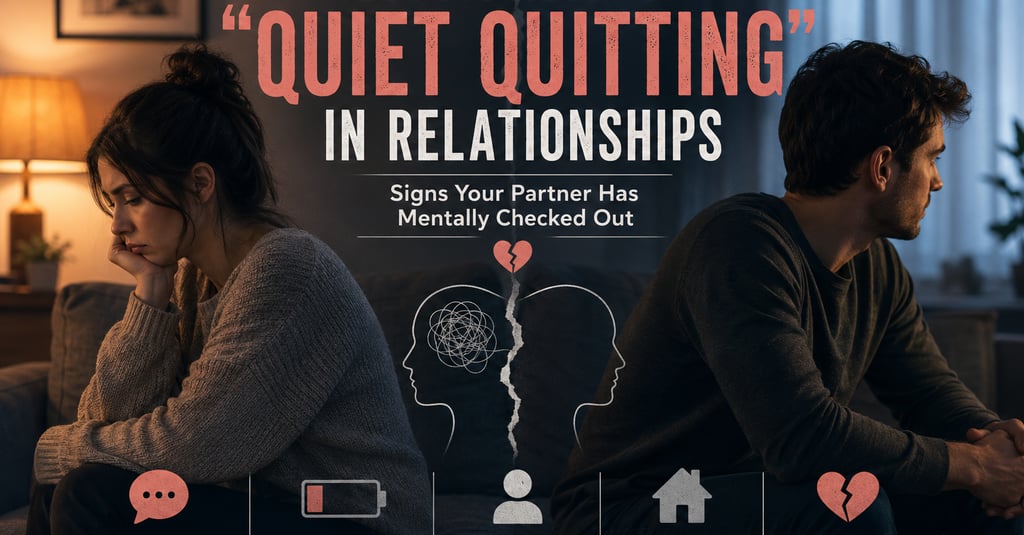
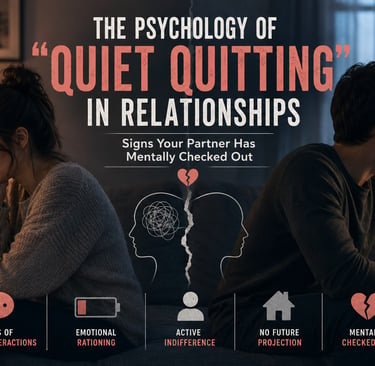
Modern relationships rarely end all at once.
More often, they fade in slow motion.
No dramatic breakup. No explosive argument. No official declaration that “it’s over.” Instead, one partner gradually stops investing emotionally while still technically remaining in the relationship. Psychologists and relationship experts increasingly describe this phenomenon as “quiet quitting” in relationships, a subtle emotional withdrawal where a person mentally checks out long before they physically leave.
The term originally exploded in workplace culture, describing employees who stopped emotionally investing beyond minimum job requirements. But in relationship psychology, the concept feels even more personal, and far more painful.
Because unlike obvious conflict, emotional detachment creates confusion.
You start wondering:
“Why do they feel distant even when they’re here?”
“Why do conversations feel empty?”
“Am I imagining this?”
“Why do they seem emotionally unavailable but still stay?”
The hardest part about quiet quitting is that it often happens silently. There are no clear boundaries or endings. Just a gradual disappearance of emotional intimacy.
Understanding the psychology behind this behaviour can help you identify the signs early, recognize deeper relationship patterns, and avoid internalizing someone else’s emotional withdrawal as your personal failure.
What Is Quiet Quitting in Relationships?
Quiet quitting in relationships refers to a psychological and emotional disengagement where one partner slowly reduces emotional investment without openly addressing their dissatisfaction.
They may still:
Text you
Live with you
Sleep beside you
Attend family events
Say “I love you”
But emotionally, they’ve already started leaving.
The relationship shifts from emotional connection to emotional maintenance.
Instead of actively nurturing intimacy, they operate on autopilot, doing the bare minimum necessary to avoid confrontation, guilt, or disruption.
This behaviour often reflects:
Emotional exhaustion
Avoidant attachment patterns
Fear of conflict
Resentment
Narcissistic relationship dynamics
Loss of emotional attraction
Internal dissatisfaction they cannot communicate directly
The result is emotional limbo: the relationship exists physically, but not psychologically.
Why Quiet Quitting Happens
Most people do not consciously decide one morning to emotionally detach from their partner.
Quiet quitting is usually gradual.
It develops when emotional needs, resentment, stress, or unresolved psychological patterns accumulate over time.
1. Emotional Burnout
Some people emotionally withdraw because they feel psychologically depleted.
Repeated arguments, unresolved tension, unmet needs, or feeling misunderstood can slowly drain emotional energy.
Instead of addressing the issue directly, they conserve emotional effort by emotionally disengaging.
This creates:
Shorter conversations
Less affection
Reduced curiosity about your life
Emotional flatness
The relationship starts feeling transactional rather than emotionally alive.
2. Avoidant Attachment Patterns
People with avoidant attachment styles often struggle with emotional vulnerability and deep intimacy.
When relationships become emotionally intense, they may subconsciously create distance to regain a sense of control.
Instead of saying:
“I’m overwhelmed emotionally.”
They unconsciously:
Pull away
Become less expressive
Stop initiating closeness
Limit emotional conversations
This emotional distancing is often self-protection rather than cruelty, though it still deeply affects the other partner.
3. Fear of Conflict
Many quiet quitters are not emotionally aggressive.
They are emotionally avoidant.
They fear:
Difficult conversations
Hurting someone
Being perceived as the “bad person”
Emotional confrontation
Guilt
So instead of openly ending the relationship, they slowly disengage while hoping the relationship naturally dissolves on its own.
Psychologically, this is passive withdrawal rather than active communication.
4. Narcissistic Relationship Patterns
In some cases, emotional withdrawal becomes part of a larger control dynamic.
Within certain narcissistic relationship patterns, emotional detachment can function as a form of emotional manipulation.
The narcissistic partner may:
Withdraw affection strategically
Become emotionally inconsistent
Ignore emotional bids for connection
Create confusion through intermittent attention
This creates psychological dependency because the other partner constantly tries to “earn back” emotional closeness.
The unpredictability itself becomes emotionally addictive.
Not every emotionally detached partner is narcissistic, but chronic emotional withholding can become a powerful control mechanism in unhealthy relationships.
The Most Overlooked Signs of Emotional Detachment
Most people expect emotional withdrawal to look dramatic.
In reality, the strongest indicators are often tiny behavioural changes called micro-interactions.
These small moments reveal emotional investment more accurately than grand gestures.
When someone mentally checks out, these micro-connections slowly disappear.
1. Loss of Micro-Interactions
Healthy relationships are built on countless tiny emotional exchanges.
Examples include:
Sending random memes
Casual touch
Eye contact during conversation
Sharing small stories
Asking follow-up questions
Inside jokes
Checking in emotionally
Remembering small details
When emotional detachment begins, these behaviours quietly fade away.
The relationship becomes functional instead of emotionally intimate.
You stop feeling emotionally “seen.”
This is one of the earliest signs of quiet quitting in relationships.
2. Emotional Rationing
Emotionally detached partners often begin rationing emotional energy.
Conversations become:
Shorter
Surface-level
Predictable
Emotionally unavailable
They may respond politely but without emotional engagement.
You notice:
Reduced enthusiasm
Minimal empathy
Delayed emotional responses
Less vulnerability
The relationship starts feeling emotionally one-sided.
3. Active Indifference
One of the most psychologically painful signs is active indifference.
Not anger.
Not jealousy.
Not frustration.
Indifference.
When someone still cares emotionally, they usually react emotionally. But quiet quitting often creates emotional neutrality.
Examples include:
Lack of concern during conflict
Emotional passivity
Minimal reaction to your sadness
Emotional absence during important moments
Indifference signals emotional disengagement more strongly than arguments ever do.
4. They Stop Repairing Conflict
Healthy couples repair emotional ruptures.
Even after arguments, emotionally invested partners usually attempt reconnection through:
Apologies
Humour
Affection
Reassurance
Problem-solving
Quiet quitters stop repairing.
They emotionally disengage instead of reconnecting.
The psychological message becomes:
“The relationship is no longer emotionally worth the effort.”
5. Reduced Future Projection
Emotionally invested people naturally imagine shared futures.
Detached partners often stop discussing:
Future trips
Marriage
Shared goals
Long-term plans
Future excitement
The relationship becomes trapped in the present because psychologically, they no longer envision permanence.
The Hidden Psychology Behind Emotional Withdrawal
One reason emotional detachment feels so destabilizing is because humans are neurologically wired for emotional responsiveness.
Relationships depend heavily on:
Validation
Attention
Emotional reciprocity
Predictability
Attachment security
When emotional responsiveness disappears, the nervous system interprets it as emotional danger.
This can trigger:
Anxiety
Overthinking
Obsessive reassurance-seeking
Hypervigilance
Emotional dependency
Ironically, the more one partner withdraws, the more the other may pursue connection — creating the classic pursuer-distancer dynamic.
This cycle intensifies emotional exhaustion for both people.
Why People Stay in Quietly Dead Relationships
Many emotionally detached relationships continue for months or even years.
Why?
Because emotional endings are psychologically more complicated than physical endings.
People stay due to:
Fear of loneliness
Financial dependence
Shared children
Emotional habit
Guilt
Social image
Trauma bonding
Hope things will improve
Some individuals also remain because intermittent affection creates emotional confusion.
Occasional moments of warmth make the relationship feel salvageable, even when the overall emotional pattern remains disconnected.
Can Emotional Detachment Be Reversed?
Sometimes.
But only if both people are psychologically willing to confront the underlying issues honestly.
Reconnection requires:
Emotional accountability
Vulnerability
Direct communication
Consistent effort
Self-awareness
Rebuilding emotional safety
However, emotional withdrawal becomes much harder to reverse when:
Resentment is deeply rooted
Emotional neglect has become chronic
Narcissistic relationship patterns exist
One partner has already psychologically exited the relationship
The key question is not:
“Can this relationship survive?”
But rather:
“Are both people still emotionally willing to participate?”
Because relationships rarely fail from lack of love alone.
They often fail from prolonged emotional disengagement.
The Most Important Thing to Remember
If your partner has mentally checked out, you may feel tempted to:
Over analyse every interaction
Blame yourself
Work harder for their affection
Ignore your emotional instincts
Accept emotional crumbs
But emotional connection cannot survive through one-sided effort alone.
A relationship requires mutual emotional presence.
Not just physical proximity.
Not just routine.
Not just history.
Quiet quitting in relationships hurts because it creates an invisible breakup, one where the body stays while the emotional connection disappears.
And sometimes the deepest heartbreak is not losing someone physically.
It’s realizing they emotionally left long before you noticed.
Final Thoughts
Understanding relationship psychology means learning to notice not only dramatic red flags, but subtle emotional shifts.
The most dangerous relationship problems are often quiet:
Emotional absence
Indifference
Withdrawal
Passive detachment
Loss of emotional curiosity
Recognizing these emotional detachment signs early can help you make healthier decisions, communicate more clearly, and protect your emotional well-being before emotional distance becomes permanent.
Because healthy love is not just about staying.
It’s about remaining emotionally present.
Frequently Asked Questions (FAQs)
What is quiet quitting in relationships?
Quiet quitting in relationships refers to a gradual emotional withdrawal where one partner stops emotionally investing in the relationship without officially ending it. They may still stay physically present, but emotionally they become distant, detached, and minimally engaged.
What are the biggest emotional detachment signs in a relationship?
Some of the most common emotional detachment signs include:
Reduced communication
Lack of emotional intimacy
Loss of affection
Indifference during conflicts
Fewer meaningful conversations
Decreased interest in your feelings or daily life
Emotional unavailability
Avoiding future plans together
These changes are usually subtle and happen gradually over time.
How do I know if my partner has mentally checked out?
A partner who has mentally checked out often:
Stops initiating connection
Shows little curiosity about your emotions
Avoids vulnerable conversations
Becomes emotionally passive
Gives minimal effort in resolving conflict
Treats the relationship like a routine rather than an emotional bond
The strongest indicator is often emotional indifference rather than open hostility.
Is quiet quitting the same as falling out of love?
Not always.
Sometimes quiet quitting happens because of unresolved resentment, emotional burnout, stress, avoidant attachment patterns, or communication breakdowns, not necessarily because love completely disappeared.
However, prolonged emotional detachment can eventually weaken emotional connection and intimacy.
Why do people quietly quit relationships instead of breaking up directly?
Many people avoid direct breakups because they fear:
Conflict
Guilt
Hurting their partner
Loneliness
Emotional confrontation
Major life changes
Instead of openly communicating dissatisfaction, they slowly reduce emotional investment while remaining physically present.
Can emotional detachment in relationships be reversed?
Yes, in some cases.
Emotional detachment can improve if both partners are willing to:
Communicate honestly
Address unresolved resentment
Rebuild emotional safety
Invest consistent emotional effort
Practice vulnerability and empathy
However, recovery becomes difficult if emotional neglect has continued for a long time or if only one partner is trying to repair the relationship.
What is the difference between needing space and emotional withdrawal?
Healthy space is temporary and communicated clearly.
Emotional withdrawal, on the other hand, involves ongoing emotional disconnection, reduced intimacy, and lack of emotional responsiveness without healthy communication.
Someone needing space still maintains emotional care and reassurance. Someone emotionally detached often becomes indifferent.
Are narcissistic relationship patterns connected to quiet quitting?
Sometimes.
Certain narcissistic relationship patterns involve emotional withholding, inconsistent affection, passive distancing, and emotional manipulation. A narcissistic partner may emotionally withdraw to create control, confusion, or dependency.
However, not every emotionally detached person is narcissistic. Emotional withdrawal can also stem from stress, trauma, avoidant attachment, or emotional exhaustion.
Why does emotional detachment feel so painful?
Humans are psychologically wired for emotional connection and responsiveness. When emotional intimacy disappears, the brain often interprets it as rejection or emotional danger.
This can trigger:
Anxiety
Overthinking
Insecurity
Emotional dependency
Constant reassurance-seeking
The uncertainty of emotional withdrawal is often more psychologically distressing than direct conflict.
Can couples therapy help with quiet quitting in relationships?
Yes.
Couples therapy can help identify:
Communication breakdowns
Unmet emotional needs
Attachment issues
Resentment patterns
Emotional avoidance behaviours
Therapy is most effective when both partners genuinely want to rebuild emotional connection rather than simply maintain appearances.
Is emotional distance always a sign the relationship is ending?
Not necessarily.
Temporary emotional distance can happen during:
Stressful life periods
Burnout
Mental exhaustion
Grief
Major life transitions
The key difference is whether both partners remain emotionally willing to reconnect and work through the disconnection together.
How can I emotionally protect myself if my partner is quietly quitting?
You can protect your emotional well-being by:
Acknowledging behavioural patterns honestly
Avoiding self-blame
Communicating directly about emotional needs
Setting healthy boundaries
Prioritizing self-respect and emotional clarity
Seeking professional support if needed
A healthy relationship requires mutual emotional participation, not one-sided emotional effort.